
Subtotal ₹0.00

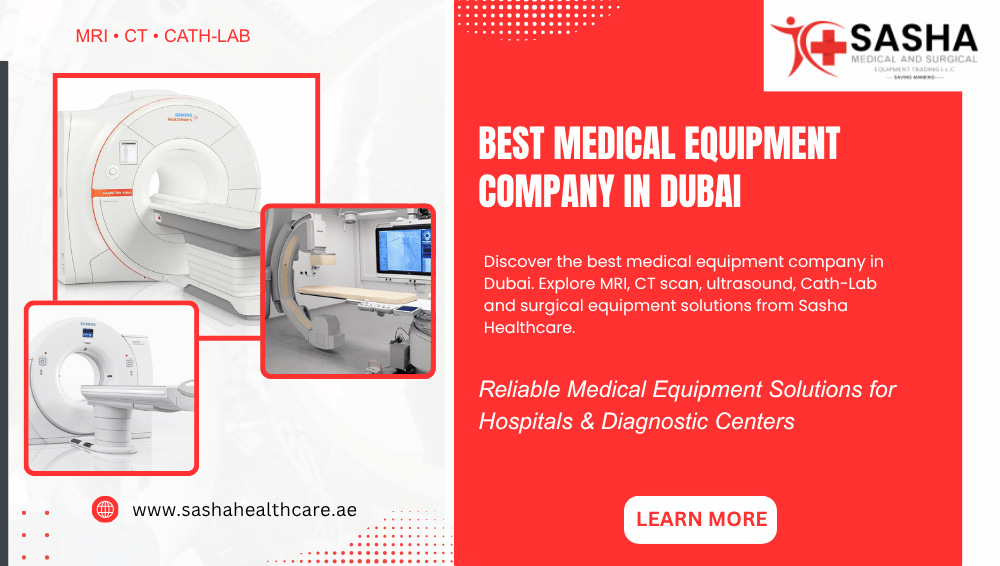
Choosing the best medical equipment company in Dubai is an important decision for hospitals, clinics, diagnostic centers, and other healthcare facilities. Medical equipment supports diagnosis, treatment, patient monitoring, and surgical procedures. Selecting the right supplier can help healthcare providers manage equipment costs, maintain operational efficiency, and obtain the technical support required for reliable performance.
Dubai’s healthcare sector includes hospitals, specialist clinics, diagnostic centers, and outpatient facilities with different equipment requirements. Some organizations need advanced imaging systems such as MRI and CT scanners, while others require ultrasound machines, surgical instruments, critical care equipment, or emergency medical devices.
Sasha Healthcare supports medical equipment requirements across a range of healthcare applications, including medical imaging and diagnostic equipment. Before selecting any supplier, healthcare organizations should evaluate product suitability, documentation, installation arrangements, maintenance support, and the total cost of ownership.
This guide explains seven important factors to consider when choosing a medical equipment company in Dubai and provides a practical checklist for making an informed purchasing decision.
What Makes a Medical Equipment Company Reliable?
A reliable medical equipment company helps healthcare facilities identify suitable equipment for their clinical, technical, and operational requirements. Beyond supplying a product, a dependable supplier should provide clear specifications, appropriate documentation, transparent commercial terms, and information about available technical support.
For healthcare organizations in Dubai, supplier selection may involve comparing local availability, delivery timelines, installation requirements, service arrangements, spare parts, and manufacturer documentation.
The best medical equipment company in Dubai for one facility may not be the best fit for another. A large hospital planning an MRI installation has different requirements from a small clinic purchasing an ultrasound system or patient monitoring equipment.
Healthcare buyers should therefore assess suppliers against a consistent set of criteria rather than relying solely on price or promotional claims.
Why supplier selection matters
The right supplier can help a healthcare facility:
- Identify equipment that meets its clinical and technical requirements.
- Compare product specifications and purchasing options.
- Plan delivery, installation, and commissioning.
- Understand warranty terms and service responsibilities.
- Review equipment documentation and applicable compliance requirements.
- Estimate ongoing costs, including maintenance, consumables, and spare parts.
- Reduce avoidable delays during equipment procurement.
A structured evaluation process helps procurement teams select equipment based on long-term value, suitability, and serviceability.
Seven Key Factors When Choosing a Medical Equipment Supplier
1. Product Range and Equipment Availability
A medical equipment supplier should offer products appropriate to the needs of the intended healthcare facility. Depending on its specialization, a supplier may provide medical imaging systems, diagnostic equipment, surgical instruments, critical care devices, or hospital equipment.
Working with a supplier that understands several equipment categories can simplify procurement discussions and help buyers compare options for different departments.
Before making a decision, confirm the specific models available, whether they are new or refurbished, their technical specifications, and the expected delivery schedule.
For example, a diagnostic center planning to expand its imaging services may need to evaluate MRI, CT scan, ultrasound, and digital X-ray systems. A hospital developing its intensive care services may prioritize infusion pumps, syringe pumps, patient monitors, and emergency equipment.
The equipment list should always be based on clinical requirements, facility design, staffing, and the intended patient population.
2. Product Quality and Documentation
Medical equipment must be suitable for its intended use and supported by appropriate documentation. Buyers should review technical specifications, manufacturer information, equipment condition, and applicable regulatory or conformity documents.
Important documents may include:
- Manufacturer datasheets and technical specifications.
- Model and serial number details.
- Equipment condition reports, where applicable.
- Warranty documentation and service terms.
- Installation and operating manuals.
- Relevant conformity and regulatory documentation.
- Maintenance and service history for used equipment, where available.
For equipment supplied to healthcare facilities in the UAE, buyers should verify applicable registration, importation, and compliance requirements with the relevant authorities and qualified professionals.
Do not assume that all products have identical certifications or regulatory status. Requirements may vary according to the device, manufacturer, intended use, and applicable regulations.
3. Installation and Commissioning
Some medical devices can be installed with limited preparation, while advanced imaging systems may require substantial planning.
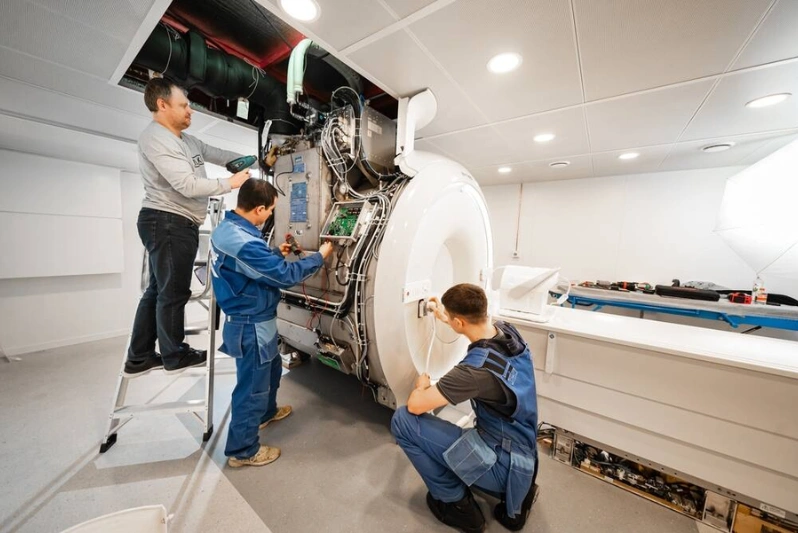
MRI and CT installations can involve room dimensions, structural considerations, electrical capacity, cooling, ventilation, shielding where applicable, network connectivity, and manufacturer-specific site requirements. MRI facilities also require particular attention to magnetic-field safety and controlled access.
Before purchasing complex equipment, clarify:
- Whether a site assessment is available.
- Who is responsible for delivery and positioning.
- Whether installation and commissioning are included.
- What building modifications may be necessary.
- Whether application training is available.
- Which acceptance tests or commissioning records will be provided.
Hospitals should coordinate equipment installation with their facilities team, clinical engineering department, radiation protection specialists where applicable, and the equipment provider.
Clear responsibilities help reduce the risk of unexpected costs or installation delays.
4. Warranty and After-Sales Support
Medical equipment may require technical assistance after installation. Warranty coverage, repair arrangements, spare parts, and access to qualified service personnel can influence the long-term value of a purchase.
Before placing an order, ask the supplier to explain the warranty period, exclusions, response arrangements, and procedures for reporting faults.
For advanced systems, clarify whether support is provided directly by the supplier, through the manufacturer, or by an authorized third-party service provider.
Important considerations include:
- Written warranty terms.
- Availability of spare parts and consumables.
- Preventive maintenance options.
- Repair and escalation procedures.
- Availability of technical documentation.
- Software and system update arrangements, where applicable.
Avoid assuming that every supplier offers the same level of after-sales service. Confirm the actual scope of support in writing before finalizing the purchase.
5. Maintenance and Technical Service
Preventive maintenance can help healthcare facilities identify equipment issues before they cause avoidable disruption. The required maintenance schedule depends on the device, manufacturer instructions, operating conditions, and applicable requirements.
When evaluating medical equipment companies in Dubai, ask whether they can explain the recommended maintenance schedule and provide access to appropriately qualified service professionals.
For high-value equipment, buyers should also understand the availability of calibration, quality-control testing, software support, and specialist servicing where relevant.
A maintenance plan should specify the equipment covered, service frequency, exclusions, spare-part arrangements, and commercial terms.
Hospitals should keep service records and follow the manufacturer’s instructions. Equipment should not be used when a fault or safety concern makes continued operation inappropriate.
6. Transparent Quotations and Total Cost of Ownership
The purchase price is only one part of the total cost of owning and operating medical equipment.
A lower-priced machine may require additional installation work, accessories, software, training, or maintenance. A more expensive option may include services that reduce separate purchasing requirements. The better choice depends on the facility’s needs and the actual terms of the quotation.
Request an itemized quotation covering relevant costs such as:
- Equipment price and included accessories.
- Delivery and transportation.
- Installation and commissioning.
- Training and application support.
- Warranty and service agreements.
- Consumables and replacement parts.
- Software licenses or upgrades, where applicable.
- Facility preparation and utility requirements.
For imaging systems, additional costs may include room preparation, specialized electrical work, cooling systems, shielding, or other site-specific modifications.
Comparing suppliers using the same equipment specifications and service requirements makes quotations more meaningful.
7. Experience Supporting Healthcare Facilities
A supplier’s experience with the required equipment category can help buyers understand installation requirements, technical specifications, and procurement considerations.
Ask for relevant product references, manufacturer information, service capabilities, and examples of comparable projects where these can be legitimately provided.
For specialized equipment, confirm whether the supplier has access to the necessary technical expertise and whether installation or servicing will be performed by appropriately qualified personnel.
Buyers should also assess how clearly the supplier communicates. Accurate specifications, timely quotations, realistic delivery commitments, and documented responsibilities are useful indicators of a professional procurement process.
Rather than relying on unsupported claims that a company is the number-one supplier, compare verifiable information and select the provider that best meets your facility’s requirements.
Types of Medical Equipment for Hospitals and Diagnostic Centers
Medical equipment requirements vary according to the services provided by each healthcare facility. The following categories are commonly considered when planning new departments, replacing existing equipment, or expanding diagnostic services.
MRI Machines
Magnetic resonance imaging systems produce detailed images of internal body structures using magnetic fields and radio waves. They are used in many diagnostic applications, including neurological, musculoskeletal, and soft-tissue imaging.
When evaluating MRI machines, consider field strength, clinical applications, patient throughput, image quality, room requirements, installation costs, service support, and the availability of compatible coils and accessories.
Facilities should also assess magnetic safety requirements and the long-term costs of operating the system.
CT Scan Machines
Computed tomography systems use X-rays to generate cross-sectional images. They support a range of clinical applications, including emergency imaging, chest examinations, abdominal studies, and other diagnostic procedures.
Relevant purchasing criteria include detector configuration, slice capability, image reconstruction technology, radiation dose management features, examination workflow, software options, and service arrangements.
The appropriate configuration depends on the facility’s patient volume, clinical services, and budget.
Ultrasound Systems
Ultrasound equipment uses sound waves to create images of internal structures. Applications include abdominal imaging, obstetrics and gynecology, vascular examinations, cardiac imaging, and point-of-care assessment.
Buyers should evaluate image quality, transducer selection, available applications, portability, workflow, software, and service support.
A compact ultrasound system may suit a clinic or bedside setting, while a specialized diagnostic center may need a more advanced configuration.
Cath-Lab Equipment
A catheterization laboratory, commonly called a Cath-Lab, supports image-guided cardiovascular procedures. Its equipment may include specialized X-ray imaging systems, patient monitoring devices, contrast injection systems, and associated accessories.
Purchasing teams should consider clinical requirements, image quality, dose-management features, room layout, integration, installation planning, staff training, and ongoing technical support.
Because Cath-Lab projects involve several interconnected systems, early coordination among clinicians, facilities teams, biomedical engineers, and suppliers is important.
Digital X-Ray Systems
Digital X-ray systems are used in hospitals, clinics, and diagnostic centers for a range of examinations. Compared with older film-based workflows, digital systems can support electronic image storage, retrieval, and integration with compatible healthcare information systems.
Evaluate detector technology, image quality, workflow, patient positioning, software compatibility, dose-management features, room requirements, and applicable radiation safety arrangements.
PET-CT Systems
PET-CT combines positron emission tomography with computed tomography to provide complementary functional and anatomical information. These systems may be used in specialized imaging services, including oncology.
A PET-CT project requires detailed planning involving clinical demand, facility design, radiation protection, radiopharmaceutical arrangements, regulatory requirements, trained personnel, and ongoing operating costs.
Buyers should evaluate the complete service requirements rather than considering only the equipment purchase price.
Surgical Instruments
Surgical instruments include devices used for cutting, grasping, clamping, retracting, suturing, and other procedures. Hospitals and surgical centers need instruments appropriate to their specialties, clinical protocols, sterilization processes, and infection-control requirements.
Before purchasing, review material specifications, instrument quality, intended use, compatibility with sterilization processes, supplier documentation, and replacement availability.
Critical Care and Emergency Equipment
Critical care and emergency departments depend on equipment suited to patient monitoring, treatment, and stabilization.
Depending on the facility, requirements may include infusion pumps, syringe pumps, patient monitors, defibrillators, suction equipment, ventilators, and emergency carts.
Procurement teams should confirm clinical suitability, alarm features, consumable compatibility, maintenance requirements, staff training needs, and integration with existing workflows.
How to Compare Medical Equipment Suppliers in Dubai
When comparing medical equipment suppliers in Dubai, use a consistent evaluation process. This helps procurement teams identify differences between quotations and avoid selecting a product based only on its initial price.
The following table provides a practical framework.
| Evaluation factor | What to check |
|---|---|
| Product suitability | Specifications, clinical applications, accessories, and compatibility |
| Documentation | Manufacturer details, condition reports, and applicable compliance documents |
| Price transparency | Itemized costs and clearly stated exclusions |
| Delivery | Confirmed lead time and transportation arrangements |
| Installation | Site requirements, commissioning, and acceptance procedures |
| Warranty | Coverage period, exclusions, and repair responsibilities |
| Maintenance | Service arrangements, spare parts, and preventive maintenance |
| Training | User training and application support, where applicable |
| Long-term costs | Consumables, software, maintenance, and expected operating costs |
A practical supplier evaluation checklist
Before selecting a supplier, healthcare procurement teams should confirm that:
- The proposed equipment meets the department’s clinical requirements.
- The quotation identifies the exact model and configuration.
- Included accessories and optional items are clearly listed.
- Equipment condition is disclosed accurately.
- Applicable regulatory and conformity requirements have been reviewed.
- Installation responsibilities are documented.
- Warranty terms are provided in writing.
- Maintenance and spare-part arrangements are understood.
- Delivery timelines and payment terms are clear.
- The supplier’s commitments can be verified.
For major equipment purchases, involve clinicians, biomedical engineers, finance teams, and facilities managers in the evaluation process.
New vs. Refurbished Medical Equipment
Healthcare facilities may consider new or refurbished equipment depending on their budget, operational needs, technology requirements, and risk tolerance.
New equipment may offer access to current configurations and manufacturer-supported warranty options. Refurbished equipment may provide an alternative for facilities seeking a particular system at a different initial purchase cost.
However, the condition, age, service history, software status, and remaining support life of refurbished equipment can vary considerably.
| Consideration | New equipment | Refurbished equipment |
|---|---|---|
| Initial cost | Generally higher | May be lower |
| Equipment condition | New from the supplier or manufacturer | Depends on refurbishment and documented condition |
| Warranty | Depends on the sales agreement | Depends on the supplier and agreement |
| Technology | May offer newer configurations | May use an earlier generation |
| Maintenance | Confirm service terms and parts availability | Check service history, parts, and remaining support |
| Documentation | Review supplied documents | Request detailed refurbishment and service records |
| Best evaluation approach | Assess suitability and lifecycle costs | Assess suitability, condition, and lifecycle costs |
Neither option is automatically the right choice for every facility. Buyers should compare the complete quotation, inspect relevant records, verify software and spare-part support, and confirm the availability of qualified maintenance.
For advanced imaging systems, a technical assessment and documented condition report are particularly important before purchasing refurbished equipment.
Questions to Ask Before Purchasing Medical Equipment
Before placing an order, ask the supplier questions that clarify the equipment’s suitability, commercial terms, and ongoing support.
Is the equipment new or refurbished?
Request written confirmation of the equipment’s condition. For refurbished systems, ask about the refurbishment process, service history, replaced components, and inspection records.
Does the quotation include installation?
Confirm whether delivery, installation, commissioning, acceptance testing, and training are included or charged separately.
What warranty is provided?
Review the coverage period, exclusions, response arrangements, and responsibility for parts and labor.
Are spare parts and technical support available?
Ask how servicing is arranged, whether qualified technicians are available, and how replacement parts can be obtained.
Does the equipment meet our clinical requirements?
Have the clinical department and biomedical engineering team review the specifications, accessories, workflow, and compatibility with existing systems.
What additional costs should we budget for?
Consider installation, facility preparation, consumables, software, maintenance, staff training, and other operating expenses.
What documentation will be supplied?
Clarify which technical manuals, equipment records, warranty documents, and applicable regulatory documents will accompany the equipment.
What is the expected delivery timeline?
Request a realistic timeline and clarify whether it depends on availability, importation, site readiness, or other conditions.
Written answers to these questions help reduce uncertainty and create a clearer basis for comparing suppliers.
Why Consider Sasha Healthcare?
Sasha Healthcare provides medical equipment solutions for healthcare facilities with requirements across medical imaging, diagnostics, and related equipment categories.
Organizations evaluating suppliers can contact Sasha Healthcare to discuss their equipment needs, request product information, and determine whether suitable options are available for their intended application.
Depending on the project, healthcare buyers may need information about MRI machines, CT scan systems, ultrasound equipment, Cath-Lab systems, surgical instruments, or other hospital equipment.
When discussing a potential purchase, buyers should share their intended clinical applications, required specifications, budget range, installation location, and preferred delivery timeline. This helps establish the scope of the requirement and makes it easier to evaluate suitable configurations.
Medical equipment solutions for different healthcare facilities
Hospitals: Equipment planning may cover multiple departments, including diagnostic imaging, critical care, emergency medicine, and operating theatres.
Diagnostic centers: Requirements may focus on imaging capacity, patient throughput, software integration, installation, and service continuity.
Specialist clinics: Buyers may prioritize equipment suited to specific examinations, space limitations, patient volumes, and clinical workflows.
Healthcare projects and expansions: Procurement teams may need to coordinate equipment selection with facility planning, utilities, installation schedules, and operational readiness.
The most appropriate equipment depends on each facility’s clinical needs and project requirements. Product specifications, availability, pricing, installation, and support should be confirmed directly before a purchasing decision.
For more information, visit the Sasha Healthcare website at https://sashahealthcare.ae/ and contact the company to discuss your medical equipment requirements.
Conclusion
Choosing the best medical equipment company in Dubai requires more than comparing product prices. Healthcare facilities should evaluate equipment suitability, documentation, installation requirements, warranty terms, maintenance support, and long-term operating costs before making a purchasing decision.
From MRI and CT scan systems to ultrasound equipment, Cath-Lab systems, surgical instruments, and critical care devices, each purchase should align with the facility’s clinical objectives, infrastructure, and budget.
A structured supplier evaluation process can help hospitals, clinics, and diagnostic centers make informed procurement decisions and plan for reliable equipment operation.
Sasha Healthcare invites healthcare organizations to explore its medical equipment solutions and discuss their requirements with the company. Contact Sasha Healthcare through https://sashahealthcare.ae/ to enquire about suitable equipment options for your facility.
Comments are closed