
Subtotal ₹0.00

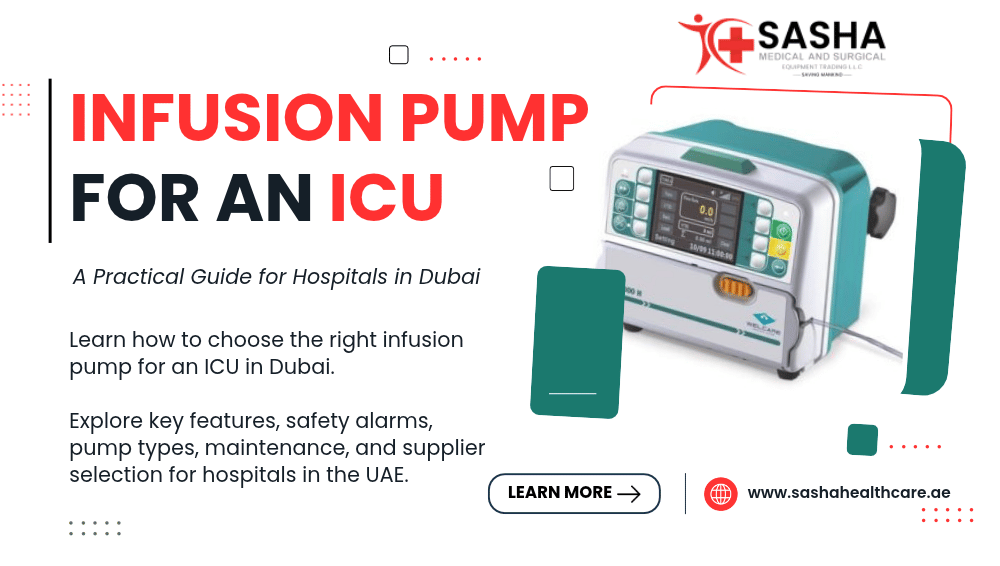
Choosing the right infusion pump for ICU in Dubai is essential for hospitals that require controlled fluid and medication delivery in critical care settings. Hospitals should evaluate clinical requirements, delivery accuracy, safety alarms, ease of use, compatibility, maintenance, and total ownership cost before purchasing an infusion pump. Selecting suitable equipment helps healthcare teams support consistent workflows and follow established patient-care protocols.
For hospitals, diagnostic centres, and healthcare facilities in Dubai and across the UAE, understanding infusion pump features can make medical equipment procurement more informed and efficient. This guide explains the key factors to consider when purchasing an ICU infusion pump.
Table of Contents
What Is an ICU Infusion Pump?
An infusion pump is a medical device designed to deliver fluids, medications, and other prescribed solutions at controlled rates. In intensive care units, these devices can support treatment protocols that require carefully managed administration.
Unlike gravity-based infusion systems, infusion pumps provide controlled delivery according to the device’s capabilities and configured settings. Healthcare professionals must select appropriate equipment for the intended application and follow the manufacturer’s instructions and hospital protocols.
Types of Infusion Pumps Used in ICUs
Understanding the available pump types helps hospitals identify equipment that suits their clinical workflows.
- Volumetric infusion pumps: Deliver specified volumes of fluid over a defined period using compatible infusion sets.
- Syringe infusion pumps: Deliver small volumes through a syringe at controlled rates, often for applications requiring precise administration.
- Smart infusion pumps: May include drug libraries and dose-error reduction features to help support safer programming.
- Multi-channel infusion systems: Allow multiple infusions to be managed through separate channels, depending on the model.
The most appropriate option depends on clinical needs, prescribed therapies, staff training, and the manufacturer’s specifications.
How to Choose the Right Infusion Pump for an ICU in Dubai
1. Assess Clinical Requirements
Start by identifying the treatments and workflows the pump must support. Consider the intended patient population, types of prescribed infusions, required delivery rates, and the ICU’s daily workload. Consult clinical and biomedical engineering teams before selecting a model.
2. Check Accuracy and Flow-Rate Range
Review the manufacturer’s stated delivery accuracy and available flow-rate range. Confirm that the device meets the requirements of the intended clinical applications. Do not assume that every infusion pump is suitable for every medication, patient, or infusion protocol.
3. Evaluate Safety Features
Look for relevant alarms and protective functions, such as occlusion detection, air-in-line detection where applicable, and anti-free-flow protection where provided. Smart pumps may offer drug libraries and dose-error reduction systems. Verify the available features for each model and ensure staff understand their proper use.
4. Consider Ease of Operation
An intuitive interface can help healthcare professionals operate equipment efficiently. Evaluate display visibility, programming steps, alarm clarity, and training requirements. Ask whether supplier-supported training or manufacturer training resources are available.
5. Verify Battery Backup and Compatibility
Battery backup may be important when pumps need to remain operational during patient transfers or temporary power interruptions. Check the expected battery performance and charging requirements.
Also verify compatibility with the specified infusion sets, syringes, accessories, and consumables. Using incompatible supplies may affect device performance and patient safety.
6. Review Maintenance and Technical Support
Reliable equipment management includes preventive maintenance, inspection, performance verification, and access to appropriate spare parts. Ask about warranty coverage, service arrangements, maintenance intervals, and the availability of technical support in Dubai or the wider UAE.
7. Compare Total Ownership Costs
Do not base purchasing decisions on the initial price alone. Consider consumables, accessories, installation, training, maintenance, warranty, and expected service life. Compare quotations using equivalent specifications and support arrangements.
Infusion Pump Price in Dubai and the UAE
The infusion pump price in UAE varies according to the manufacturer, model, features, condition, accessories, warranty, and service arrangements. Smart pumps and specialised configurations may have different costs from basic models.
When comparing new and refurbished equipment, assess documentation, service history where available, condition, suitability, warranty, and applicable regulatory requirements. Request a detailed quotation to understand the complete cost of ownership before making a purchasing decision.
Questions to Ask an Infusion Pump Supplier in Dubai
Before purchasing an infusion pump, ask the supplier:
- Does the model meet our ICU’s intended clinical requirements?
- What delivery accuracy, flow rates, and safety features does it offer?
- Which infusion sets and accessories are compatible?
- What warranty, maintenance, and technical support are available?
- Can product documentation and applicable UAE compliance information be provided?
- Are training and spare parts available?
These questions help procurement teams compare options and make informed decisions.consumable availability, and technical support.
A reliable infusion pump for ICU in Dubai should offer features appropriate for the hospital’s clinical requirements. These may include occlusion alarms, battery backup, an intuitive interface, and other protective functions, depending on the model.
Hospitals purchasing an infusion pump for ICU in Dubai should also consider staff training, preventive maintenance, consumable availability, and technical support.
Finding the Right ICU Infusion Pump Supplier
Choosing an infusion pump for ICU in Dubai involves more than comparing purchase prices. Hospitals should evaluate product documentation, warranty terms, after-sales service, and the availability of compatible accessories.
Before purchasing an infusion pump for ICU in Dubai, consult clinical and biomedical engineering teams to confirm that the selected model meets the facility’s requirements.
Conclusion
Choosing the right infusion pump for ICU in Dubai requires careful evaluation of clinical needs, accuracy, safety features, compatibility, maintenance, and total ownership costs. Hospitals should involve clinical and biomedical engineering teams and verify the manufacturer’s specifications before purchasing.
Sasha Healthcare LLC supports healthcare equipment procurement in Dubai and the UAE. Contact Sasha Healthcare to discuss your hospital’s infusion pump requirements and request information about suitable equipment options.
Comments are closed