
Subtotal ₹0.00

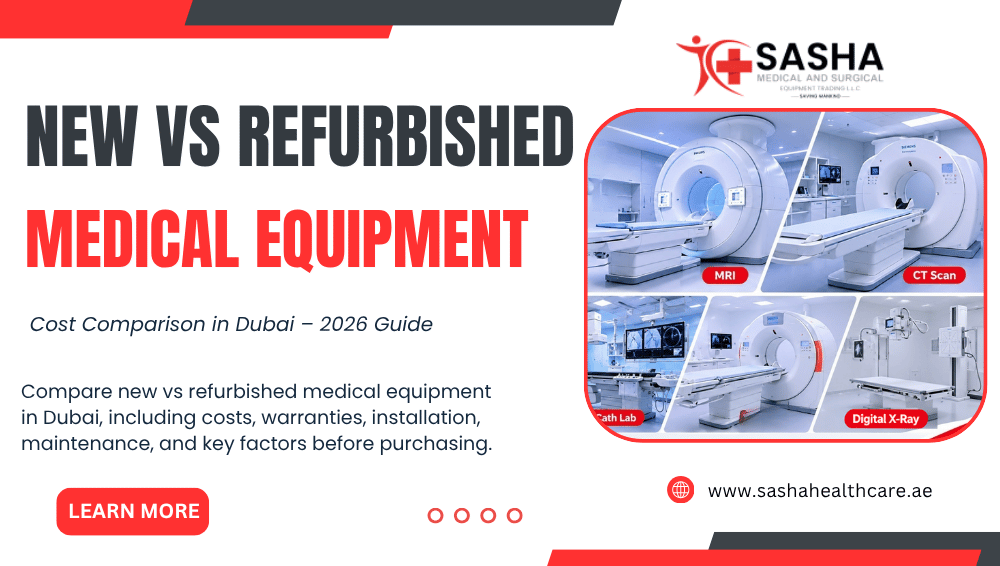
When planning a hospital, clinic, diagnostic centre, or medical facility in Dubai, medical equipment cost in Dubai is one of the most important factors in procurement decisions. Buyers often compare new and refurbished MRI machines, CT scanners, ultrasound systems, digital X-ray systems, Cath Lab equipment, and surgical equipment to determine which option fits their clinical requirements and budget.
The cost of medical equipment is not determined by the purchase price alone. Brand, model, technology, configuration, installation, warranty, maintenance, accessories, software, spare parts, and site preparation can all affect the final investment.
For healthcare organizations in Dubai, the decision between new and refurbished equipment should therefore be based on clinical requirements, equipment condition, expected utilization, service support, warranty, and total cost of ownership rather than purchase price alone.
This guide explains the key differences between new and refurbished medical equipment, the factors that influence prices, and how hospitals and diagnostic centres can compare quotations more effectively.
Table of Contents
Medical Equipment Cost in Dubai: What Determines the Price?
The medical equipment cost in Dubai can vary considerably between equipment categories and individual models. Two machines serving a similar clinical purpose can have substantially different prices because of differences in technology, specifications, configuration, age, software, and support.
The major factors affecting medical equipment pricing include:
| Cost Factor | Impact on Price | What Buyers Should Check |
|---|---|---|
| Brand | Different manufacturers have different pricing structures | Manufacturer reputation and local support |
| Model | Newer generations may have different specifications and capabilities | Model year and technical specifications |
| Configuration | Additional features can increase the quotation | Exact configuration and options |
| Equipment condition | New and refurbished systems have different acquisition costs | Condition and refurbishment documentation |
| Accessories | Coils, probes, detectors, tables and other accessories affect cost | Included accessories |
| Software | Advanced applications can increase equipment value | Software licenses and versions |
| Installation | Complex systems may require specialized installation | Whether installation is included |
| Warranty | Warranty coverage affects the overall commercial package | Duration and coverage |
| Service contract | Preventive and corrective maintenance add ongoing costs | SLA and service inclusions |
| Spare parts | Availability can influence long-term operating costs | Local and manufacturer parts support |
| Site preparation | Imaging equipment may require specialized infrastructure | Electrical, HVAC, shielding and room requirements |
For this reason, a buyer should compare complete quotations rather than comparing only the equipment’s headline price.
New vs Refurbished Medical Equipment in Dubai
The choice between new and refurbished medical equipment depends on the healthcare facility’s requirements, budget, workload, technology needs, and long-term operating strategy.
New medical equipment is supplied as new equipment from the manufacturer or authorized supply chain. It generally provides access to the manufacturer’s current or recent technology, depending on the model.
Refurbished medical equipment is previously used equipment that has undergone a refurbishment process. The quality of refurbishment can vary, so buyers should examine technical documentation, service history, replacement parts, testing, warranty, and supplier support.
The following comparison provides a general framework:
| Factor | New Equipment | Refurbished Equipment |
|---|---|---|
| Purchase price | Usually higher initial investment | Can require a lower initial investment |
| Equipment condition | New | Previously used and refurbished |
| Technology | Often newer-generation technology | Depends on model and availability |
| Warranty | Manufacturer/supplier warranty may be available | Supplier or refurbishment warranty may be available |
| Installation | Usually available as part of procurement | Depends on supplier package |
| Maintenance | Manufacturer or supplier support may be available | Depends on model, parts and service provider |
| Parts availability | Generally easier for supported models | Must be verified for older models |
| Expected service period | Depends on model and utilization | Depends on age, condition and maintenance |
| Customization | More configuration options may be available | Limited to the available system |
| Initial investment | Generally higher | May be lower |
| Technology lifecycle | Usually longer from date of purchase | Remaining lifecycle must be evaluated |
Neither category should automatically be treated as suitable for every healthcare facility. The right choice depends on the specific application and procurement requirements.
New Medical Equipment Cost in Dubai
Purchasing new medical equipment involves more than paying for the machine itself. A quotation may include several components that determine the final project cost.
For example, a new MRI system may involve the scanner, coils, software applications, patient table, accessories, installation, testing, training, warranty, and service support.
Similarly, the cost of a new CT scanner can depend on factors such as detector configuration, number of slices, software applications, workstation specifications, accessories, installation requirements, warranty, and service agreement.
Common Components of a New Equipment Purchase
A new equipment quotation may include:
- Equipment and standard configuration
- Optional accessories
- Software applications
- Workstations
- Installation
- Site inspection
- Commissioning
- User training
- Warranty
- Preventive maintenance
- Technical support
- Spare parts
- Delivery and logistics
Before comparing two quotations, buyers should make sure that the specifications are comparable.
A lower quotation may not necessarily represent a lower total cost if important accessories, installation, training, or service coverage are excluded.
Refurbished Medical Equipment Cost in Dubai
Refurbished medical equipment can provide an alternative procurement route for healthcare facilities seeking to manage their initial capital expenditure.
However, the term refurbished should not simply be treated as synonymous with used equipment.
A professionally refurbished system may undergo inspection, cleaning, component replacement, testing, calibration, software checks, and other technical procedures. The exact refurbishment process depends on the equipment category, manufacturer, model, age, condition, and supplier.
What Can Affect Refurbished Equipment Cost?
Important factors include:
- Original manufacturer
- Model
- Manufacturing year
- Previous usage
- Service history
- Equipment condition
- Availability of replacement components
- Refurbishment work performed
- Software version
- Accessories included
- Warranty
- Installation
- Technical support
- Spare parts availability
Two refurbished machines of the same model may therefore have different commercial values depending on their condition and service history.
Professionally Refurbished vs Used Equipment
Healthcare buyers should distinguish between:
Used equipment: Previously operated equipment that may be sold with limited inspection or refurbishment.
Refurbished equipment: Previously operated equipment that has undergone a defined refurbishment and testing process.
When evaluating refurbished equipment, ask the supplier to provide documentation describing what was inspected, repaired, replaced, tested, and warranted.
New vs Refurbished Medical Equipment Cost Comparison
A useful cost comparison should look at the equipment category and the actual configuration rather than applying a single percentage difference between new and refurbished equipment.
MRI Machines
MRI pricing can vary substantially depending on:
- Magnet strength
- 1.5 Tesla or 3 Tesla configuration
- Manufacturer and model
- Number and type of coils
- Gradient performance
- Software applications
- Patient table
- Workstation
- Cooling requirements
- Installation
- Warranty
- Service agreement
A refurbished MRI system may have a different acquisition cost from a new system, but buyers should also consider remaining equipment lifecycle, replacement parts, software support, and service availability.
CT Scanners
CT scanner cost can be influenced by:
- Slice configuration
- Detector technology
- Tube condition
- Tube specifications
- Reconstruction software
- Cardiac applications
- Dose-management features
- Workstation
- Accessories
- Installation
- Warranty
- Service contract
When comparing new and refurbished CT scanners, the technical specification should be matched carefully. Comparing machines based only on the advertised slice count can produce misleading results.
Ultrasound Systems
Ultrasound pricing depends on:
- System category
- Manufacturer
- Probe configuration
- Imaging technologies
- Doppler capabilities
- Cardiac applications
- 3D/4D functions
- Software packages
- Workstation
- Accessories
For refurbished ultrasound equipment, buyers should check probe condition carefully because probes are important components of the system.
Digital X-Ray Systems
Digital X-ray systems can vary according to:
- Detector type
- Detector size
- Generator specifications
- Table configuration
- Tube specifications
- Software
- Image-processing system
- Workstation
- Installation
- Accessories
The buyer should confirm whether detectors, workstation equipment, software, installation, and training are included in the quotation.
Cath Lab Equipment
Cath Lab systems involve complex infrastructure and specialized components. Cost considerations may include:
- Imaging system
- Detector
- C-arm configuration
- Patient table
- Imaging software
- Hemodynamic monitoring
- Workstations
- Accessories
- Installation
- Room preparation
- Service support
For refurbished Cath Lab equipment, the condition and supportability of major components should be carefully evaluated.
Total Cost of Ownership: More Than the Purchase Price
One of the most important concepts in medical equipment procurement is Total Cost of Ownership (TCO).
TCO represents the broader cost associated with acquiring, installing, operating, maintaining, and eventually replacing equipment.
A simplified formula is:
Total Cost of Ownership = Purchase Cost + Installation + Site Preparation + Training + Maintenance + Repairs + Consumables/Parts + Software/Support − Applicable Residual Value
The exact calculation will differ between equipment categories.
Costs to Consider
Before purchasing equipment, consider:
- Equipment purchase price
- Shipping and logistics
- Installation
- Site preparation
- Electrical infrastructure
- HVAC or cooling requirements
- Radiation shielding where applicable
- Network infrastructure
- Training
- Preventive maintenance
- Corrective maintenance
- Spare parts
- Software updates
- Service contracts
- Downtime
- Decommissioning
- Future replacement
For high-value imaging systems, these additional costs can have a meaningful impact on the overall investment.
Advantages and Considerations of New Medical Equipment
New equipment may offer access to newer technology and manufacturer-supported configurations. However, it also generally involves a larger initial capital investment.
Potential Benefits
- Access to newer-generation technology
- New equipment condition
- Manufacturer warranty options
- More configuration choices
- Access to current software and applications
- Potentially longer remaining technology lifecycle
- Manufacturer or authorized service support
- Availability of training programs
Considerations
- Higher initial capital requirement
- Potentially higher acquisition cost
- Site preparation requirements
- Ongoing maintenance costs
- Technology lifecycle considerations
- Potentially higher costs for optional software and accessories
The buyer should evaluate whether the additional features and capabilities are actually required for the facility’s clinical workload.
Advantages and Considerations of Refurbished Medical Equipment
Refurbished equipment can be considered when a facility wants to manage the initial investment while obtaining an established equipment platform.
Potential Benefits
- Potentially lower initial acquisition cost
- Access to established equipment models
- Availability of proven configurations
- Potential suitability for facilities with defined clinical requirements
- Possibility of obtaining equipment with refurbishment warranty and service support
Considerations
Buyers should carefully evaluate:
- Equipment age
- Service history
- Previous operating environment
- Refurbishment quality
- Replacement parts
- Software support
- Warranty
- Technical service
- Expected remaining lifecycle
- Downtime risk
- Availability of qualified engineers
The condition and support package should be evaluated individually for every refurbished system.
What to Check Before Buying Refurbished Medical Equipment in Dubai
Before purchasing refurbished medical equipment, request detailed information from the supplier.
1. Manufacturer and Model
Confirm the exact manufacturer, model, configuration, and serial number where applicable.
2. Manufacturing Year
Ask for the manufacturing year and installation history.
3. Service History
Request available maintenance and service records.
4. Refurbishment Documentation
Ask what work was performed during refurbishment.
For example:
- Which components were replaced?
- Which components were inspected?
- What testing was performed?
- Was calibration completed?
- Was software checked?
5. Equipment Testing
Confirm whether the equipment underwent technical and operational testing before delivery.
6. Software Version
Check whether the installed software supports the clinical applications required by your facility.
7. Replacement Parts
Ask about spare-parts availability and expected support for the model.
8. Warranty
Review exactly what the warranty covers, including parts, labor, response time, and exclusions.
9. Installation
Confirm who is responsible for installation, commissioning, testing, and site acceptance.
10. Training
Determine whether operator and technical training are included.
11. Service Contract
Compare preventive maintenance and corrective maintenance options.
12. Downtime Support
Ask about technical response times and escalation procedures.
13. Regulatory Requirements
Confirm that the equipment and installation process meet the applicable requirements for your facility and intended use in the UAE.
New vs Refurbished: Which Cost Factors Matter Most?
There is no single cost model that applies to every hospital or diagnostic centre.
The decision may depend on:
Available Capital Budget
Facilities with a limited capital budget may evaluate refurbished equipment alongside new equipment.
Clinical Workload
A high-volume diagnostic centre may require equipment specifications and service arrangements designed for intensive utilization.
Technology Requirements
If a facility requires specific advanced applications or the latest available technology, the range of suitable equipment may differ from a facility with more basic requirements.
Patient Volume
Expected patient volume can influence the importance of throughput, uptime, service response, and equipment capacity.
Equipment Lifecycle
Older equipment may require closer evaluation of parts availability, software support, and future serviceability.
Service Availability
For both new and refurbished equipment, access to qualified technical support can be an important procurement consideration.
Downtime Tolerance
Facilities with high equipment utilization should evaluate how service response and spare-parts availability could affect operations.
How to Compare Medical Equipment Quotations in Dubai
Comparing quotations only by price can make procurement decisions difficult. Instead, use a structured technical and commercial comparison.
Step 1: Define Clinical Requirements
Identify the examinations, procedures, patient volume, and clinical applications the equipment must support.
Step 2: Define Technical Specifications
Prepare a specification sheet before requesting quotations.
Step 3: Request Multiple Quotations
Ask suppliers to provide detailed commercial and technical proposals.
Step 4: Compare Configurations
Make sure each supplier is quoting equipment with comparable specifications.
Step 5: Compare Warranty
Review warranty duration, coverage, exclusions, and response time.
Step 6: Compare Installation
Confirm whether installation, commissioning, testing, and site inspection are included.
Step 7: Compare Service Contracts
Review preventive maintenance, corrective maintenance, engineer response, and parts coverage.
Step 8: Verify Spare Parts
For refurbished equipment, investigate parts availability particularly carefully.
Step 9: Calculate Total Cost of Ownership
Include purchase, installation, maintenance, repairs, software, accessories, and other relevant costs.
Step 10: Review Supplier Credentials
Consider the supplier’s experience, technical capabilities, service network, and ability to support the equipment after installation.
Step 11: Confirm Regulatory Requirements
Make sure the equipment and installation arrangements meet applicable UAE requirements.
Step 12: Complete Technical and Commercial Evaluation
The final procurement decision should consider both technical suitability and the complete commercial package.
Questions to Ask a Medical Equipment Supplier
Before placing an order, healthcare buyers can ask:
- What is the exact manufacturer and model?
- Is the equipment new, used, or professionally refurbished?
- What is the manufacturing year?
- What is included in the quoted configuration?
- Are accessories included?
- What software is installed?
- What is included in the warranty?
- How long is the warranty?
- Is installation included?
- Is user training included?
- Is preventive maintenance available?
- What is the expected service response time?
- Are spare parts readily available?
- What refurbishment or testing has been performed?
- Can the supplier provide service and maintenance documentation?
- What site requirements must be completed before installation?
- What are the expected delivery and installation timelines?
- Are there additional costs outside the quotation?
Getting clear answers to these questions can make it easier to compare suppliers and avoid unexpected expenses.
Medical Equipment Procurement Checklist
Before purchasing new or refurbished medical equipment in Dubai, use the following checklist:
- Clinical requirements defined
- Technical specifications documented
- Manufacturer and model verified
- Equipment condition verified
- Manufacturing year checked
- Service history reviewed
- Refurbishment documentation reviewed
- Software configuration checked
- Accessories confirmed
- Installation included or separately quoted
- Site requirements identified
- Warranty reviewed
- Maintenance options reviewed
- Spare-parts availability confirmed
- Training requirements confirmed
- Regulatory requirements reviewed
- Total cost of ownership calculated
- Supplier technical support evaluated
- Delivery timeline confirmed
- Final technical and commercial quotation reviewed
Why Supplier Support Matters in Dubai
Medical equipment is a long-term investment. The supplier relationship can therefore continue well beyond delivery.
After installation, healthcare facilities may require:
- Preventive maintenance
- Corrective repairs
- Spare parts
- Software support
- Technical troubleshooting
- Equipment calibration
- User training
- Equipment relocation
- Emergency repair services
For imaging equipment such as MRI and CT systems, specialized technical support can be particularly important because equipment downtime can interrupt scheduled diagnostic services.
When comparing suppliers, evaluate the complete support package rather than considering the initial equipment quotation alone.
Medical Equipment Suppliers in Dubai: What Buyers Should Evaluate
When selecting medical equipment suppliers in Dubai, healthcare organizations can evaluate several practical factors.
Product Portfolio
Check whether the supplier can provide the categories of equipment required by the facility.
Technical Expertise
Evaluate whether the supplier has appropriate technical knowledge for installation, commissioning, maintenance, and troubleshooting.
Refurbishment Standards
For refurbished equipment, ask for details about inspection, component replacement, testing, calibration, and warranty.
Service Support
Understand the supplier’s service coverage and response procedures.
Documentation
Ensure technical specifications, warranty information, installation requirements, and service documentation are clearly provided.
After-Sales Support
Consider the availability of spare parts, maintenance services, technical assistance, and training.
SASHA MEDICAL AND SURGICAL EQUIPMENT TRADING L.L.C provides medical equipment solutions for healthcare organizations and can assist buyers evaluating equipment requirements, configurations, installation, and service considerations in Dubai and the UAE.
Conclusion
Understanding medical equipment cost in Dubai requires more than comparing two purchase prices. New and refurbished equipment can have different acquisition costs, technology levels, service requirements, warranties, and expected lifecycles.
For new equipment, buyers should evaluate the latest suitable technology, configuration, manufacturer support, warranty, installation, and long-term maintenance requirements. For refurbished equipment, greater attention should be given to equipment age, service history, refurbishment quality, component condition, software, spare-parts availability, warranty, and technical support.
The most useful comparison is therefore based on clinical suitability and total cost of ownership.
Whether you are purchasing an MRI machine, CT scanner, ultrasound system, digital X-ray system, Cath Lab equipment, or surgical equipment, request detailed technical and commercial quotations and compare the complete package before making a procurement decision.
For healthcare facilities in Dubai and across the UAE, working with an experienced medical equipment supplier can help simplify equipment selection, installation, maintenance, and after-sales support.
What is the average medical equipment cost in Dubai?
There is no single average price for medical equipment in Dubai. Costs vary according to the equipment category, manufacturer, model, configuration, condition, accessories, installation, warranty, and service requirements. A supplier quotation based on the required specification provides a more meaningful cost estimate.
Is refurbished medical equipment cheaper than new equipment in Dubai?
Refurbished equipment can have a lower initial acquisition cost than comparable new equipment, but the difference varies by model, age, condition, refurbishment work, configuration, and warranty. Buyers should compare total cost of ownership rather than purchase price alone.
How much can refurbished medical equipment reduce initial costs?
There is no universal percentage that applies to all refurbished equipment. Savings depend on the specific model, age, condition, configuration, refurbishment work, availability, and supplier package. Buyers should request an equipment-specific quotation.
How do I choose a medical equipment supplier in Dubai?
Compare suppliers based on product suitability, technical specifications, equipment condition, pricing, warranty, installation, technical support, spare-parts availability, service capabilities, documentation, and after-sales support.
What is included in the total cost of medical equipment?
Depending on the equipment, total costs may include the machine, accessories, software, shipping, installation, site preparation, training, maintenance, spare parts, service contracts, and other operational expenses.
Comments are closed